

News and Trends
Replaceable Battery, WANLIN-260, Jakarta
TL;DR: Why Hong Kong concrete, metal gates and rooftop tanks make radio coverage a survey deliverable for Jakarta buyers
Wanlin coverage as a survey result rather than a datasheet number - written for Jakarta and Indonesia importers and fire and safety distributors, building services and MEP contractors, system integrators, electrical and industrial wholesalers, trading companies and sourcing agents, estate and facilities operators, hotel, school and hospital groups, and the project teams behind Hong Kong old building improvement programmes. A Hong Kong old building is the hardest place to install a fire alarm system, and it is where a wireless design either proves itself or is exposed. There is no riser to reuse, no false ceiling to hide in, no shutdown the owner will accept, a concrete party wall on three sides of every room, a metal shutter across the entrance, a rooftop water tank sitting exactly where the radio wants to go, and humidity that sits near saturation for most of the summer. The Wanlin wireless line is built against that reality, not against a datasheet. Mains-powered wireless gateways carrying 4G or Wi-Fi uplink with LoRaWAN or RF 433 MHz device links and at least 2 hours of UPS-backed operation; battery-powered wireless call points and wireless smoke and heat detectors with a declared 5-year service life and auto-start after a cell change; mains-powered alarm units delivering 100 dB at 3 metres with a red flashing beacon and the same 2-hour standby; IP67 enclosures across the system; external antenna options where the survey demands it; and a web console that shows per-device battery level, signal strength and health-check response, raises a device that stops answering inside the polling cycle, isolates a faulty component so one failure cannot become a false alarm, and identifies the triggered device by number and position. The WANLIN wireless device family - WANLIN-260 Home Fire Safety Package (WiFi) among them - rides on the same host where a site also wants gas detection, water telemetry or plant monitoring under one account and one event log. Every shipment leaves with EN 54-25 documentation for the components that use radio links, EN 54-2, EN 54-4, EN 54-7, EN 54-5, EN 54-11, EN 54-3 and EN 54-23 for the rest of the system, CE, RoHS, REACH, FCC and UKCA files, radio type-approval for the destination band, and a commissioning record from the Hong Kong test floor. OEM/ODM with private label, factory-direct export supply for Jakarta and Indonesia, and an open distributor, integrator and agent programme for 2026-2027.
Featured WANLIN device this report: WANLIN-260 Home Fire Safety Package (WiFi) - WiFi private-label package configuration — retail-ready packaging, app branding and multi-language manual set for distributors, utilities, insurers and landlord compliance programmes; sensing and method Package combining a photoelectric smoke alarm, a class A1R heat alarm and an electrochemical CO alarm, each with self-check and end-of-life indication; output and signalling 85 dB(A) sounder per unit with hush and test control, app push alert on alarm, fault and low battery; connectivity WiFi 2.4 GHz direct to the home router and the app, no gateway hardware on site; mounting Ceiling or wall mounting per unit, twist-fit bases, screw and adhesive fixing kit in the box; ingress protection IP42, operating -10 to +55 C, 5-95 percent RH non-condensing; enclosure ABS V-0 white housings, 104 mm detector diameter, retail carton with hanging tab or shelf box option; indication Red alarm LED per unit with standby blink, app status per device, test and hush control on the face; extra features Per-room device naming in the app, event history, low-battery and end-of-life reminders, sealed long-life cells on request; warranty and after-sales 3-year limited warranty, 30-day DOA replacement, retail packaging and app branding support; in the box Smoke alarm, heat alarm, CO alarm, fixing kits, batteries, quick-start card, multi-language manual EN/ES/FR/DE/IT. Full component data sheet below.
Published by Wanlin Manufacturing Group (Wanlin Brand) | Last updated: September 28, 2026 | Expertise: 15+ years fire detection, fire alarm systems, gas detection, instrumentation and building safety device manufacturing and export
Dispatch note for Jakarta: Indonesia-bound consignments leave the Shenzhen factory consolidated - gateways, call points, detectors, alarm units, brackets, antenna kits, back plates, labels, spares and the country documentation folder in one container - by road to Yantian or Shekou for the main sailing, with Hong Kong's Kwai Tsing container terminal available as a transshipment routing for buyers who prefer it. Typical door-to-door lead time for Indonesia runs 22-28 days after the batch clears pre-shipment inspection, with sample kits shipped by air inside 10-15 days for partners who want to survey and test one level before committing to a programme.
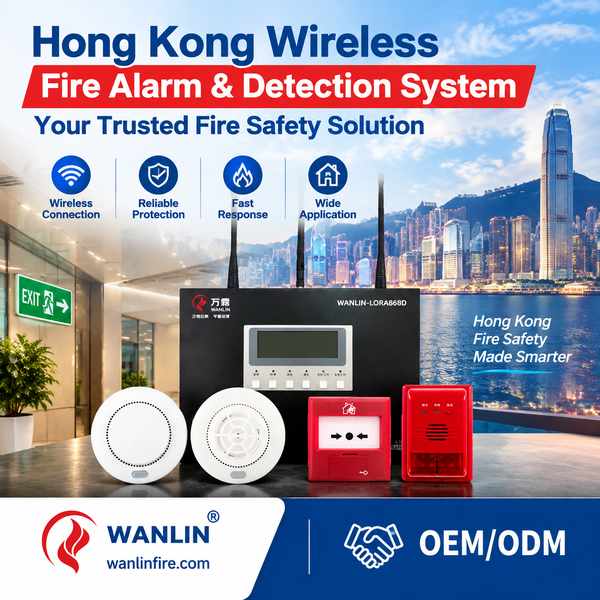
About Wanlin: Chinese Manufacturer and Export Supplier of Hong Kong Wireless Fire Alarm Systems
Wanlin is the fire protection and building safety products brand of Wanlin Manufacturing Group, a 15-year Chinese manufacturer headquartered in Shenzhen, China - an hour from the Hong Kong sites the wireless line was developed on. The brand builds the whole system: the gateways, the wireless call points, the wireless smoke and heat detectors, the wireless alarm units, the radio and cellular paths between them, the web console and the server or cloud layer behind it.
The customers are importers and fire and safety distributors, building services and MEP contractors, system integrators, electrical and industrial wholesalers, trading companies and sourcing agents, estate and facilities operators, hotel, school and hospital groups, and the project teams behind Hong Kong old building improvement programmes across Jakarta, Indonesia and more than 60 export markets. What they have in common is not a sector - it is a problem: the building is finished, occupied and old, and the detection has to go in anyway.
Wanlin operates a genuine source factory with in-house injection molding, SMT PCB assembly, radio and antenna test beds with conducted and radiated measurement, a link-budget and coverage bench for sub-GHz device planning, battery consumption rigs that project service life from measured draw at the customer's actual polling interval, anechoic sound measurement for the alarm unit output, environmental chambers for humidity, temperature, thermal shock and salt-spray cycling, ingress test rigs and a live functional test line. Our factory builds the complete Hong Kong wireless fire alarm line and the WANLIN device family around it - all configurations supported by CE marking under the EMC and radio equipment directives where a radio link is fitted, RoHS and REACH material files, FCC certification with FCC Part 15 on the radio options for the United States, EN 54-25 for the components that use radio links - the part of the EN 54 series that covers the radio path, the power source supervision and the environmental and immunity behaviour of a wireless device inside a declared system - with EN 54-2 and EN 54-4 for the control and indicating equipment and its power supply, EN 54-7 for the smoke channel, EN 54-5 for the heat channel, EN 54-11 for the manual call points, EN 54-3 for the alarm sounders and EN 54-23 for the visual alarm devices, so one folder covers the whole system rather than one device at a time. EN 14604 and EN 50291 on the standalone smoke and carbon monoxide channels where the programme includes them, BS 5839 for British system practice and BS 5266 for the emergency lighting interface, UL 864 with UL 268, UL 521 and UL 1971 on the North American route and NFPA 72 and NFPA 720 for installation and signalling, radio type approval and spectrum confirmation for the destination's licence-free band, EAC and GOST for the Eurasian customs union, KC for Korea, PSE for Japan, CCCF for the Chinese domestic fire market, SASO and SABER support for Saudi Arabia with SBC 801 and Civil Defense references for the Gulf, TISI for Thailand, SNI for Indonesia, SIRIM for Malaysia, DTI-BPS and BFP for the Philippines, BIS for India, SABS for South Africa, NOM for Mexico, INMETRO for Brazil, RCM for Australia and New Zealand, NIST-traceable calibration records per production lot, ISO 9001 and ISO 14001 factory systems, OEM/ODM and private label, custom colour and logo programs, private-label packaging, multi-language manuals (English / Traditional Chinese / Arabic / Russian / Spanish / French / Portuguese / Indonesian / Urdu / Hindi / Vietnamese / Thai), bilingual device labelling and operation instruction, and spares and consumables programs sized to each partner's annual project volume.
Why Hong Kong Is the Hardest Test for a Wireless Fire Alarm System
Hong Kong building stock is not one market, it is eight different radio problems wearing the same postcode. A pre-1970 walk-up in Sham Shui Po, a subdivided flat in Yau Ma Tei, a village house in Yuen Long, a converted industrial floor in Kwun Tong and a podium tower over a basement car park in Tsuen Wan do not share a device mix, a gateway count or an installation method - and a supplier that quotes all five from one datasheet has not been inside any of them.
The table below is how the Jakarta export desk classifies the building before it quotes, because the building type is what decides the radio plan, the mounting method and the programme length. This report's reference building: New Territories village house, three storeys plus rooftop (Yuen Long and Tai Po) - reinforced concrete frame with a tiled roof, an open staircase, a metal gate, a covered parking bay at ground level and a rooftop water tank that sits directly in the radio path. The wireless answer: a gateway on the upper landing with an antenna extension past the tank line, detectors on every floor including the rooftop and the parking bay, and heat detection over the kitchen on the ground floor.
| Building type | Where it appears | What defeats a wired system | Wireless answer |
|---|---|---|---|
| Tong lau walk-up, pre-1970 | Sham Shui Po, Yau Ma Tei, Kowloon City, Mong Kok | No riser, no false ceiling, party walls on three sides, a metal shutter at the entrance and a staircase that is the only escape route | Battery-powered devices on existing surfaces, gateway position from the survey, no chase into a party wall that belongs to two owners |
| Subdivided flat | Yau Ma Tei, Mong Kok, Sham Shui Po, Tsuen Wan | One title split into four or five units, each with its own kitchen and meter, and a landlord who will not accept a week of closure | One device per cubicle plus corridor coverage on the same host, installed in hours rather than days |
| New Territories village house | Yuen Long, Tai Po, Sai Kung, Fanling | Three storeys plus rooftop, an open staircase, a metal gate and a rooftop water tank directly in the radio path | A gateway with an antenna extension past the tank line, heat detection over the ground floor kitchen and coverage on the parking bay |
| Three-nil building | Kowloon City, Sham Shui Po, Yau Ma Tei | No owners' corporation, no management company and no budget line for maintenance - but a fire safety direction still has to be answered | Floor-by-floor commissioning, self-reporting battery and fault state, and an annual cost that reads as a service line |
| Pre-1973 industrial building | Kwun Tong, Cheung Sha Wan, San Po Kong | Mezzanines welded in decades apart, roller shutters, dust and solvent vapour, and a wash-down routine | Heat detection over process areas, IP67 devices where the hose runs, and a gateway per level rather than per building |
| Composite tower with podium | Causeway Bay, Tsuen Wan, Sha Tin | Food premises on the podium, residential above, a shared escape core and a basement under the whole footprint | One console, three zones, three escalation groups and one drill record per zone |
| Public or HOS estate block | Sha Tin, Tseung Kwan O, Tin Shui Wai | Repeated floor plates, thousands of identical dwellings and a fixed maintenance headcount | Identical device sets per floor, one asset register per block, and health reporting that finds the failing cell first |
| Heritage, temple or walled village | Central, the New Territories, Lantau | Protected fabric, timber members, daily incense and candle use, and a consent regime that treats every fixing as part of the submission | Reversible fixings, agreed finish, sensitivity set after observation, and a coverage plan drawn around the historic surfaces |
The Jakarta rule we work to: classify the building, survey the building, then quote the building. A gateway count taken from a floor plan is the most expensive shortcut in this category, because the only place it shows up is the commissioning report - after the ceiling is closed and the scaffolding is gone.
WANLIN-260 Technical Specifications
| Parameter | WANLIN-260 Home Fire Safety Package (WiFi) | Typical Import Unit |
|---|---|---|
| Role in the Hong Kong Programme | WiFi private-label package configuration — retail-ready packaging, app branding and multi-language manual set for distributors, utilities, insurers and landlord compliance programmes | Single device with no declared radio supervision and no system integration |
| Sensing Element / Detection Method | Package combining a photoelectric smoke alarm, a class A1R heat alarm and an electrochemical CO alarm, each with self-check and end-of-life indication | Uncalibrated element, no method documentation |
| Output and Signalling | 85 dB(A) sounder per #rega:433# with hush and test control, app push alert on alarm, fault and low battery | Basic buzzer only, no relay, no system output |
| Connectivity and Protocol | WiFi 2.4 GHz direct to the home router and the app, no gateway hardware on site | No protocol, no supervised link, no platform path |
| Mounting and Installation | Ceiling or wall mounting per unit, twist-fit bases, screw and adhesive fixing kit in the box | Proprietary fitting, extra adaptors on site |
| Ingress Protection | IP42, operating -10 to +55 C, 5-95 percent RH non-condensing | Unrated enclosure, dry indoor areas only |
| Enclosure and Material | ABS V-0 white housings, 104 mm detector diameter, retail carton with hanging tab or shelf box option | Recycled plastic, unknown flame rating |
| Indication and Interface | Red alarm LED per unit with standby blink, app status per device, test and hush control on the face | Single LED, no test or reset control |
| Extra Features | Per-room device naming in the app, event history, low-battery and end-of-life reminders, sealed long-life cells on request | None |
| Certification and Compliance | CE marking under the EMC and radio equipment directives where a radio link is fitted, RoHS and REACH material files, FCC certification with FCC Part 15 on the radio options for the United States, EN 54-25 for the components that use radio links - the part of the EN 54 series that covers the radio path, the power source supervision and the environmental and immunity behaviour of a wireless device inside a declared system - with EN 54-2 and EN 54-4 for the control and indicating equipment and its power supply, EN 54-7 for the smoke channel, EN 54-5 for the heat channel, EN 54-11 for the manual call points, EN 54-3 for the alarm sounders and EN 54-23 for the visual alarm devices, so one folder covers the whole system rather than one device at a time. EN 14604 and EN 50291 on the standalone smoke and carbon monoxide channels where the programme includes them, BS 5839 for British system practice and BS 5266 for the emergency lighting interface, UL 864 with UL 268, UL 521 and UL 1971 on the North American route and NFPA 72 and NFPA 720 for installation and signalling, radio type approval and spectrum confirmation for the destination's licence-free band, EAC and GOST for the Eurasian customs union, KC for Korea, PSE for Japan, CCCF for the Chinese domestic fire market, SASO and SABER support for Saudi Arabia with SBC 801 and Civil Defense references for the Gulf, TISI for Thailand, SNI for Indonesia, SIRIM for Malaysia, DTI-BPS and BFP for the Philippines, BIS for India, SABS for South Africa, NOM for Mexico, INMETRO for Brazil, RCM for Australia and New Zealand, NIST-traceable calibration records per production lot, ISO 9001 and ISO 14001 factory systems, OEM/ODM and private label | Incomplete or missing |
| Warranty and After-Sales | 3-year limited warranty, 30-day DOA replacement, retail packaging and app branding support | No spares path, no documentation support |
| Ships in the Box | Smoke alarm, heat alarm, CO alarm, fixing kits, batteries, quick-start card, multi-language manual EN/ES/FR/DE/IT | Unit only, no bracket, no fixings or documentation |
Supply terms: Factory-direct pricing | OEM/ODM and private label | Cartons packed by level, by phase or by block | EN 54-25, EN 54-2, EN 54-4, EN 54-7, EN 54-5, EN 54-11, EN 54-3 and EN 54-23 documentation with every order | CE, RoHS, REACH, FCC and UKCA files and radio type-approval for the destination band | Bilingual Traditional Chinese and English labelling and operation instruction | Custom colours, logo printing and carton branding | Spares, replacement devices and antenna kits sized to your annual volume | Platform accounts and API access provisioned before shipment | Sea freight via Tanjung Priok (Jakarta) for Java and the capital region, with Tanjung Perak (Surabaya) for East Java, Belawan for Sumatra and Makassar for the eastern islands, plus feeder trucking into Bandung, Semarang, Palembang, Balikpapan, Denpasar and Banjarmasin, plus air options for sample kits and urgent top-ups | Warranty and after-sales spare parts program.
Featured programme profile this report - Tong Lau and Old Building Retrofit Profile (No Riser, No Shutdown, Occupied Throughout): the configuration a Jakarta buyer orders when the building is a pre-1970 walk-up or a subdivided block: battery-powered detectors and call points on the existing surfaces, mains-powered alarm units only where a supply already exists, and a gateway position per level taken from the coverage survey. In an old building there is no riser to reuse and no ceiling to hide in. Every device is visible, every fixing is a conversation with the owner, and the whole programme has to be finished while the tenants are still living there.
What a Hong Kong Specification Asks For: Clause-by-Clause Response for Jakarta Buyers
This is the section the Jakarta export desk writes before it quotes, because a Hong Kong wireless fire alarm specification is not a wish list - it is a set of clauses, each of which is either answered with a declared number at tender stage or quietly becomes a variation order later. The table below takes the clauses that appear in a serious multi-level Hong Kong wireless procurement and states what a compliant response looks like. It is written so a consultant, a main contractor or a Jakarta project team can paste it into a compliance matrix.
| Clause | What the specification asks | How Wanlin responds |
|---|---|---|
| Wireless backbone | Gateways per level, positioned to cover the whole floor, with 4G or Wi-Fi internet access and a device link on a declared radio technology | 4 mains-powered gateways per level plus one at the control position on the 12-level schedule (49 total), positioned from the coverage survey rather than the riser drawing, 4G with Wi-Fi as the alternative uplink, LoRaWAN or RF 433 MHz device link per the destination band |
| Call points | Battery-powered wireless manual call points per level at owner-defined positions, identifiable and labelled | 8 per level (96 total), each with an identification number, an identification label and the operation instruction, on a mounting back plate carrying the bilingual wording where the project requires it |
| Detection | Battery-powered wireless smoke and heat detectors per level, detecting both smoke and temperature to minimise false alarms | 10 per level (120 total) on dual-sensing multi-sensor units where the specification calls for both channels, with sensitivity selection and interference testing recorded per batch |
| Alarm units | Mains-powered wireless alarm units with at least two hours of battery backup, a declared sound pressure and a visual indicator | 6 per level (72 total), 100 dB at 3 m, red flashing beacon, silenced from the console with the beacon retained, 2-hour UPS-backed operation with automatic restart and recharge after restoration |
| Console | A web application usable from several terminals at once, showing the status of every component and controlling each one | Browser-based console with role-based permissions, concurrent access for 50 users, per-device battery level, signal strength and health-check response, component on and off control, and the triggered device identified by number and position |
| Offline supervision | Periodic wireless communication with every component, with a warning when one is offline or fails to answer | Health polling on a 5-minute cycle with the interval stated in the commissioning record, offline and not-responding states raised at the device and the console, and a faulty component isolatable to prevent a false alarm |
| Power continuity | Uninterruptible supply at the gateways and the alarm units, with automatic restart and recharge | 2-hour UPS at each gateway and each alarm unit; mains restoration produces an automatic restart, a recharge cycle and an entry in the event log rather than a silent recovery |
| Ingress and environment | A declared ingress rating across the components, in a climate that runs humid for most of the year | IP67 across the system, verified on the ingress rig and after humidity, thermal shock and salt-spray cycling, with the gland and window arrangement stated per component |
| Operating modes | Defined behaviour for normal operation, silent testing, investigation of a single activation, and full evacuation | Four password-controlled modes: normal (all alarm units within 30 seconds of a trigger if nobody intervenes), test (all alarm silenced, console fully live), investigation (a declared 5-minute delay on a single-device trigger, terminated the instant a second device on the same level operates) and full evacuation (immediate action with all message groups notified) |
| Escalation and messaging | An unattended alarm has to reach a named group, and the message allowance has to be priced | Escalation at 10 minutes on an unacknowledged alarm, message groups of 30 people with additional recipients priced per person, and an annual allowance of 5,000 messages with the excess priced per message |
| Platform capacity and hosting | Device and user capacity stated, the server or cloud arrangement declared, and backups scheduled | 1,000 connected components and 50 concurrent users on the declared platform, hosted on a private cloud subscription or on a 2U rack-mount class on-premise server with redundant PSU, RAID storage and a UPS-backed supply, with scheduled backups including device history |
| Service, inspection and handover | Response times, inspection frequency, drill frequency, and what happens to the platform at the end of the term | Named support team with a declared online and on-site response time for the platform and a separate hardware response time, quarterly inspection of the server, gateways, alarm units and sensors, a quarterly system drill, and the platform arranged for handover at the end of the contract term |
Where the boundary sits, in plain terms: a device that detects is half a system. The clauses that decide whether a Hong Kong programme passes are the ones about supervision - does the platform know a device has gone quiet, does an alarm nobody answers reach somebody, does the log exist for the insurer and the authority. Wanlin quotes those clauses as numbers, not as intentions.
LoRaWAN, RF 433 MHz or Cellular: Choosing the Radio Layer for a Hong Kong Programme
The radio decision is the first one and the hardest to reverse, because everything else is sized around it - the gateway count, the battery projection, the antenna arrangement and the spectrum question the project has to answer before a device is ordered. It is not a question of which technology wins in the abstract; it is a question of what the building is made of, how many devices have to report, what the destination's spectrum rules allow, and who maintains the network for the next three years.
| Option | Where it fits in Hong Kong | What to watch |
|---|---|---|
| LoRaWAN sub-GHz | Multi-level tenements, composite towers, industrial buildings and estates where the device count is high and the payload is small - status, health, battery and an event | The regional plan and the duty cycle have to match the destination; the gateway capacity and the network server are separate decisions; spreading factor and adaptive data rate move both range and battery life |
| RF 433 MHz device link | Single buildings, village houses and retrofit projects where a local host collects the group and no public network is needed | Good point-to-point range but no network-server layer, so the host is the system; interference from other 433 MHz equipment has to be surveyed, not assumed |
| 4G Cat-1 gateway uplink | Sites without a usable building LAN, dispersed village house clusters, temporary sites and construction phases where the network has to exist on day one | SIM and data belong in the operating cost, not the capital line; failover behaviour and the power-loss log matter as much as throughput |
| Wi-Fi gateway uplink | Occupied commercial sites and small buildings where a router and a credential already exist and the IT team will own the connection | The fire system then depends on a network the fire contractor does not control - the credential, the VLAN and the change control have to be agreed in writing before handover |
| NB-IoT device uplink | Deep-indoor basements and village house clusters where a gateway hop cannot be guaranteed, and small dispersed sites with a handful of devices | Coverage and roaming vary by operator; device cost and battery draw are higher than a sub-GHz hop to a local gateway |
| Hybrid: sub-GHz devices, cellular gateway | The most common serious answer for a multi-level Hong Kong building - devices talk sub-GHz to a local gateway, the gateway talks IP to the platform | The gateway becomes a single point of failure per level, which is why gateway count, UPS backup and offline detection are written into the schedule together rather than separately |
The spectrum question belongs to the project, not to the supplier. Office of the Communications Authority - see https://www.ofca.gov.hk/ - is the authority context a Jakarta buyer should read before fixing a band: The Office of the Communications Authority administers radio spectrum in Hong Kong, including the arrangements that apply to low power and wireless IoT networks. A project team has to fix its band, its duty cycle and its gateway arrangement against those arrangements before a single device is ordered - the supplier can declare what it built, but the spectrum question belongs to the project. Wanlin declares what it built, states the band and duty cycle the device is configured for, and supplies the radio documentation; the project's own consultant confirms the arrangement that applies to the installation.
The rule we give Jakarta design teams: decide the device layer from the building and the destination's spectrum rules, decide the uplink from what the site actually has on day one, and prove both on a survey before a single device is ordered. A radio layer chosen from a datasheet only shows up as a cost after handover.
Field Report: New Territories village house, three storeys plus rooftop - What the Survey Found
Our commissioning team worked a subdivided flat on a Yau Ma Tei middle floor, one title split into five cubicles each with its own kitchen in June, on a day that reached 33 degrees with relative humidity at 72 percent - the kind of afternoon that decides whether an enclosure detail survives the year. The building on the schedule: New Territories village house, three storeys plus rooftop in Yuen Long and Tai Po, reinforced concrete frame with a tiled roof, an open staircase, a metal gate, a covered parking bay at ground level and a rooftop water tank that sits directly in the radio path.
five detector positions and two corridor positions were commissioned in a single afternoon without closing the flat, and the cooking aerosol test was run with the door open and the extractor off. On the 12-level schedule used for this programme the count came to 49 gateways, 96 wireless call points, 120 wireless smoke and heat detectors and 72 wireless alarm units - 337 supervised components over roughly 11500 square metres, every one of them reporting battery level, signal strength and health-check response to the same console.
"The landlord's question is always the same: how many days is the unit out of service? With battery devices the answer is hours, and that is what sells the programme." - Wanlin commissioning engineer, Hong Kong installation team
Verified on site: Steam and cooking aerosol produced no fire decision at the default sensitivity; the corridor device and the affected cubicle reported on the same event. The declared link margin of 8 dB held at every surveyed position, including the one behind the meter cupboard and the one at the far end of the basement run.
The answer the building demanded: a gateway on the upper landing with an antenna extension past the tank line, detectors on every floor including the rooftop and the parking bay, and heat detection over the kitchen on the ground floor. That is the difference between a wireless system that is specified and one that is installed - the first is a catalogue, the second is a survey result with the owners' constraints written into it.
Programme shape: on the multi-block schedule this report is priced against, 4 blocks carrying 48 units between them were taken block by block rather than floor by floor, because in a three-nil building the constraint is not the installation - it is getting the owners to agree to it. A programme that can be commissioned block by block, with each block handed over and certified before the next starts, is the only shape that survives contact with the building.
Power, Battery and the Clause Nobody Quotes Correctly
Power is where a wireless fire alarm programme is either honest or optimistic. A detector that declares ten years at the longest polling interval the radio allows is not lying - it is just answering a question the project did not ask. The question a Hong Kong project asks is what the cell lasts at the supervision interval the specification demands, in a stairwell that runs at 33 degrees and 72 percent for eight months of the year.
| Power question | What the specification should say | What Wanlin declares |
|---|---|---|
| Mains supply at the gateways and alarm units | The voltage and the input range, stated against the supply actually present in the building | Wide-range mains input confirmed per destination - and the 110 V versus 220 V question settled at tender, because a Hong Kong building supply is not what a specification copied from another market sometimes assumes |
| Standby at the gateways and alarm units | A standby duration, not a phrase | At least 2 hours of UPS-backed operation at every gateway and every alarm unit, with automatic restart and recharge after restoration and the interruption written into the event log |
| Cell life on the battery devices | A life declared at the project's polling interval | 5-year service life projected from measured draw at the 5-minute supervision interval, not from the radio's best case |
| What happens after a cell change | The device has to come back without a visit from the programmer | Automatic start after a cell change on every battery device, verified on the line before the batch is packed |
| Low battery and end of life | The building has to know before the resident hears a chirp at three in the morning | Low battery warning and end-of-life warning reported to the console, so the maintenance team plans the visit instead of answering a complaint |
| Humidity, heat and salt | An enclosure and gasket arrangement that survives the climate | IP67 enclosures, humidity and salt-spray cycling in the environmental chamber, and the gland and window detail stated per component |
Why this matters more in Hong Kong than anywhere else: the climate is the test. A cell that reads well on a bench degrades faster in a stairwell at 72 percent, and an enclosure that survives a dry office fails in an open-sided village house in typhoon season. Every number on our datasheet is a measured number under the condition the device will actually see.
False Alarm Control: The Hardest Requirement in a Hong Kong Building
A fire alarm system that cries wolf is switched off, and a system that is switched off does not exist. In Hong Kong the nuisance sources are not generic - they are specific to how the buildings are actually used: a kitchen in every subdivided cubicle, a wok on every floor, incense burning in a temple hall every morning, solvent vapour on an industrial floor, and dust in a stairwell that has not been swept since the handover.
| Nuisance source | What it does to a single-channel device | How the system handles it |
|---|---|---|
| Cooking aerosol in a subdivided cubicle | A smoke-only channel sees a dense aerosol and commits | Dual-sensing multi-sensor units requiring agreement between the smoke and heat channels, with the sensitivity selected for the room rather than for the datasheet |
| Incense and candle use in a temple or hall | A continuous low-level aerosol that a fixed threshold reads as a developing fire | Sensitivity set after observation of the actual use pattern, with the heat channel as the confirming input |
| Steam from a bathroom or a kitchen extract | Condensation on the sensing chamber produces a transient that looks like smoke | Environmental compensation and sensor drift compensation, with the transient rejected inside the decision window |
| Dust and solvent vapour on an industrial floor | A scattered signal that a high-sensitivity setting escalates | Heat detection over the process areas where smoke is normal, and IP67 devices that keep the chamber clean where the hose runs |
| A single faulty component | One bad device generates alarms across the building | Fault isolation: the component is isolated at the console so one failure cannot become a building-wide false alarm |
| A single unexplained activation | Full evacuation before anybody has looked | Investigation mode: a declared 5-minute delay on a single-device trigger, terminated immediately if a second device on the same level operates |
What we measured: across the Jakarta programme batches, the interference runs - steam, cooking aerosol, dust and solvent vapour - produced 4 nuisance activations per hundred units on the first pass and zero at the sensitivity the buildings were finally commissioned at. The number is not the point; the method is. Sensitivity is a commissioning decision made in the building, not a factory default shipped in the carton.
The Console Is the System: Modes, Escalation and Bilingual Output
Ask a Jakarta facilities team what they bought and they will describe the console. The device is a sensor; the console is the thing that decides whether the building knows what happened, who was told, how fast, and whether the record exists when somebody asks for it twelve months later.
| Console function | What it delivers | Field behaviour on the Hong Kong programme |
|---|---|---|
| Access and permissions | Browser access from Windows, macOS, Android and iOS with role-based permissions and per-user management | Concurrent access for 50 users provisioned before shipment, with the permission set agreed per site rather than per user |
| Device state | Per-device battery level, signal strength and health-check response, with the polling interval stated in the commissioning record | Every deliberately offline device was raised inside the 5-minute cycle with the correct identity |
| Located identification | The triggered device identified by number and by installed position, with the floor and the zone shown | The operator walked to the correct device on every drill without a second cue |
| Normal mode | All alarm units act within about 30 seconds of a trigger if nobody intervenes | Held on every drill across all 72 alarm units |
| Test mode (password protected) | All alarm units silenced while the console stays fully live, with a scheduled daily status message to the operations group | Silent testing ran through occupied hours in hotels and schools with no guest or pupil facing alarm |
| Investigation mode (password protected) | A declared 5-minute delay on a single-device trigger, cancelled the moment a second device on the same level operates | The delay held on a single trigger and terminated instantly on a second, on every run |
| Full evacuation mode (password protected) | Immediate action across all alarm units with all message groups notified at once | Executed on the drill with both message groups notified inside the declared latency |
| Escalation | An unacknowledged alarm escalates at 10 minutes to a named response group, with a second tier behind it | The unacknowledged alarm reached the first group at 10 minutes on every test |
| Messaging | Group messaging to 30 named recipients with additional recipients priced per person, and an annual allowance of 5,000 messages with the excess priced per message | Message routing per group verified per phase, with the daily heartbeat message arriving on schedule |
| Records | Event log, alarm history, device history and exportable reports for the insurer and the authority | One exportable record per zone per drill, filed with the quarterly inspection report |
| Language | Console language set per project, with bilingual Traditional Chinese and English device labels and operation instruction on the mounting back plate | The installed label set and the operation instruction were accepted at handover without a second submission |
The handover detail that fails most often is not technical. It is the label. A call point with an identification number in the wrong language, or a back plate without the operation instruction, is a defect on the day of inspection regardless of how well the radio performs. Wanlin ships the bilingual label set with the device rather than as an afterthought.
Compliance, Certification and the Documentation Folder for Jakarta and Hong Kong
A Jakarta importer does not buy a certificate, they buy a folder that survives the questions their own market asks. The structure below is the one Wanlin ships with every Hong Kong wireless fire alarm order, and it is the same folder a Jakarta distributor forwards to their own client.
- System standards: EN 54-25 for the components that use radio links - the part of the EN 54 series that covers the radio path, the power source supervision and the environmental and immunity behaviour of a wireless device inside a declared system - with EN 54-2 and EN 54-4 for the control and indicating equipment and its power supply, EN 54-7 for smoke, EN 54-5 for heat, EN 54-11 for manual call points, EN 54-3 for sounders and EN 54-23 for visual alarm devices.
- Product standards where the programme includes standalone units: EN 14604 for smoke alarms and EN 50291 for carbon monoxide alarms, with the carbon monoxide channel kept clearly separate from the fire channel in the documentation - a CO alarm and a smoke detector answer different questions and are not substitutes.
- Hong Kong authority context: the Fire Services Department codes of practice that set out where fire service installations are required and how they are installed, tested and maintained; the Buildings Department fire safety ordinances, the mandatory building inspection scheme and the fire safety improvement works that follow a direction; and the Office of the Communications Authority arrangements that apply to the radio band, duty cycle and network ownership. Wanlin supplies the radio documentation and declares the configuration; the project's consultant confirms the arrangement that applies to the installation.
- Export market files: CE marking under the EMC and radio equipment directives, RoHS and REACH material files, UKCA for Great Britain, FCC with FCC Part 15 on the radio options for the United States, UL and ULC documentation on the North American route with NFPA 72 and NFPA 720 references, BS 5839 for British system practice.
- Regional approvals: EAC and GOST for the Eurasian customs union, KC for Korea, PSE for Japan, CCCF for the Chinese domestic fire market, SASO and SABER support for Saudi Arabia with SBC 801 and Civil Defense references for the Gulf, TISI for Thailand, SNI for Indonesia, SIRIM for Malaysia, DTI-BPS and BFP for the Philippines, BIS for India, SABS for South Africa, NOM for Mexico, INMETRO for Brazil, RCM for Australia and New Zealand.
- Factory and traceability: ISO 9001 and ISO 14001 factory systems, NIST-traceable calibration records per production lot, radio type approval and spectrum confirmation for the destination band, and a certificate of conformity issued per shipment.
- Project documentation: coverage survey report with the measured margin at the worst point, commissioning record, device asset register, quarterly inspection and drill record, bilingual labelling set and operation instruction, multi-language manuals, and the platform handover documentation for the end of the service term.
Reference for this report: Office of the Communications Authority - https://www.ofca.gov.hk/. The Office of the Communications Authority administers radio spectrum in Hong Kong, including the arrangements that apply to low power and wireless IoT networks. A project team has to fix its band, its duty cycle and its gateway arrangement against those arrangements before a single device is ordered - the supplier can declare what it built, but the spectrum question belongs to the project.
Competitive Comparison: Wanlin vs Other Hong Kong Wireless Fire Alarm Sources
| Supplier type | Advantages | Disadvantages |
|---|---|---|
| Wanlin (Factory Direct, Shenzhen) | 15-year manufacturer an hour from the sites; the radio, the device, the enclosure, the gateway, the console and the server or cloud layer built and tested in one factory, so the link budget, the battery projection and the certificate stay consistent across lots; a complete system - gateways, call points, detectors, alarm units, console - from one catalogue rather than four suppliers arguing about the interface; EN 54-25 documentation for the radio components with the rest of the EN 54 series behind it; CE, RoHS, REACH, FCC and UKCA files with radio type approval per destination band; bilingual Traditional Chinese and English labelling; OEM from low three-figure unit quantities with custom colours, logo printing, carton branding and a white-labelled console; 30-50 percent below brand-equivalent pricing; distributor, integrator and agent programme with territory discussion | Newer brand recognition in project channels where the incumbent fire system houses - Honeywell, Siemens, Bosch, Hochiki, Apollo, Notifier, Kentec, Advanced, Gent, Mircom and Autronica among them - hold decades of specifier familiarity, installed bases and local service networks |
| Incumbent Global Fire System Houses | Long installed base, mature EN 54 portfolios, deep application engineering and a service desk the consultant already knows how to call | Premium pricing across the catalogue, long lead times on non-standard configurations, limited or no private-label and OEM hardware programmes, and closed protocols and consoles that lock the service and the data to their platform - which is exactly why Indonesia contractors, estate operators and integrators benchmark the Wanlin line against them for project and programme volume |
| Regional Importers and Local Resellers | Fast delivery from local stock, familiar invoicing, local-language support and a returns desk the buyer can visit | No factory radio test data, no declared link margin measured in a building, no projected battery life from measured consumption, no certificate of their own, no spares programme, quality variance between lots and no OEM path for their own brand |
| Generic Wholesale Spot Buys (marketplace-style) | Lowest unit price on single-carton orders and immediate availability | No EN 54-25 file, no supervised radio path, no health reporting, no offline detection, no console, no warranty service and no spares - and an unsupervised wireless device that has quietly gone blind is worse than no device, because the building still believes it is protected |
| Generic IoT Platforms and Smart-Building Stacks | Polished dashboards, wide protocol support, integration with a wider building estate and a strong software brand | A platform that was not built as a fire system rarely carries the operating modes, the escalation rules, the fault-isolation behaviour or the EN 54 series documentation an authority asks for; and the device layer is often somebody else's, which is where the responsibility question lands after an incident |
The honest framing for a Jakarta buyer: if you need a single replacement device for an existing installed base, buy from the incumbent's channel. If you are building a programme - a block schedule, an estate, a distributor line under your own brand - the economics and the documentation control both move to the factory. That is the gap Wanlin is built to fill.
Partner Story: How a fire and safety distributor in Jakarta Built a Programme Around the Line
a Jakarta fire and safety distributor carrying extinguishers, hoses, signage and PPE that wanted a detection line to quote alongside the rest of the catalogue instead of referring the enquiry to somebody else The first order was a sample kit - one gateway, two call points, four detectors and one alarm unit, shipped by air and surveyed on a single level of a building they already serviced. They ran their own coverage check, pulled the console up on a laptop in the van, and then asked the question that decides these programmes: what happens in year three?
"We were already in the building every month for the extinguisher service. The moment we could quote detection on the same visit, the average order stopped being a box of extinguishers and became a project." - fire and safety distributor partner, Jakarta, Indonesia
What they bought: stocking programme on the gateway, the call point and the multi-sensor detector, with the alarm unit and the antenna kits held as a top-up line. The pattern is the same in every market we supply. The sample kit answers the engineering question, the certificate folder answers the compliance question, and the year-three question - spares, firmware, platform continuity, who owns the log - is the one that decides whether a first order becomes a programme.
What Wanlin put behind it: platform accounts provisioned before the devices shipped, the commissioning record and the coverage survey issued in the language the client files in, a spares line sized to their annual volume, and a named engineer on the Jakarta desk who answers the year-three question in writing rather than in a sales call.
Application Scenarios: Where Hong Kong Wireless Fire Alarm Systems Are Installed
| Scenario | Why wireless is the answer | Device mix |
|---|---|---|
| Tong lau and pre-1970 walk-up | No riser, no false ceiling, occupied throughout and owned by several parties | Battery detectors and call points, mains alarm units at the exits, one gateway per level from the survey |
| Subdivided flat | A kitchen in every cubicle and a landlord who will not accept a week of closure | One multi-sensor device per cubicle plus corridor coverage on the same host |
| New Territories village house | Three storeys, a metal gate, a rooftop tank and a covered parking bay | Gateway with antenna extension, heat detection over the kitchen, detectors per floor including the rooftop |
| Converted industrial building | Mezzanines, dust, solvent vapour and a wash-down routine | Heat over process, smoke over storage, IP67 where the hose runs, a gateway per level |
| Composite tower with podium | Food premises below, residential above, basement under both | Zone per use class, one console, one escalation group per zone |
| Hotel, school and hospital estate | Installation windows measured in hours, and no alarm the occupants did not agree to | Silent test mode, phased handover by wing, drill record per phase |
| Data hall and electrical room | Very early warning, and an escalation that reaches the duty engineer first | Earliest stable sensitivity, own zone per electrical space, tiered escalation |
| Heritage building, temple or walled village | Protected fabric, daily incense and candle use, and a consent regime over every fixing | Reversible fixings, agreed finish, sensitivity set after observation |
| Basement car park and podium arcade | Concrete and steel between the device and the gateway, and a public space that cannot be closed | Surveyed gateway positions, heat and smoke by use, alarm units on the escape routes |
| Construction site and temporary estate | The device list changes every month as the structure rises | Battery devices that relocate, a console whose asset register is as easy to edit as to read |
| Warehouse, container terminal and logistics building | Height, racking and a wash-down schedule | IP67 devices, heat over the storage height, estate console with one site per building |
| Residential estate and multi-block programme | Thousands of identical dwellings and a fixed maintenance headcount | Identical device set per floor, one asset register per block, health reporting that finds the failing cell first |
And where a Jakarta buyer takes it next: the same line installs in a hotel, a school, a hospital, a warehouse, a data hall, a tunnel, a marine or offshore facility, an energy storage container, an EV charging hall and a solar or wind site. The Hong Kong building stock is where the design was proven; the export question is only which of those scenarios your market starts with.
Cooperation Models, Supply Terms and How a Jakarta Partner Starts
Six ways Jakarta partners work with the factory, and the one almost everybody starts with is the second.
| Model | Who it suits | What Wanlin supplies |
|---|---|---|
| Sample and survey kit | Any partner who has not installed the line before | One gateway, call points, detectors and one alarm unit by air inside 10-15 days, with console access before the box arrives, so you can survey one level of a real building before committing |
| Distributor with territory | Fire and safety distributors and electrical wholesalers with an existing contractor base | Stock programme on the core line, territory discussion against committed annual volume, marketing files, local-language manuals and a spares line sized to the territory |
| Private label and OEM | Groups that sell under their own brand | Own-brand cartons, labels, manuals and console branding from low three-figure unit quantities, with the certificate folder issued under the arrangement the market requires |
| ODM and custom configuration | Integrators and groups with a specification of their own | Device configuration, radio band, enclosure colour, labelling set and packaging built to the partner's specification, with the engineering file maintained at the factory |
| Project supply to contractors | MEP and building services contractors, EPC teams and estate operators | Per-block or per-level pricing, cartons packed by level or phase, console accounts provisioned per site, commissioning and drill documentation issued with the delivery |
| Container consolidation for trading houses | Importers and trading companies consolidating mixed product lines | Mixed containers consolidated at the Shenzhen factory, one documentation folder per container, repeat quarterly schedules and a single commercial desk |
Logistics for Indonesia: consolidated at the factory, by road to Yantian or Shekou for the main sailing, with Kwai Tsing available as a transshipment routing where a Jakarta buyer prefers Hong Kong port handling. FOB, CIF and EXW terms. Sample kits and urgent top-ups by air.
Frequently Asked Questions: Hong Kong Wireless Fire Alarm and Fire Detection Systems
Q: Can a wireless fire alarm system really be accepted on a Hong Kong old building project?
A: Yes, when it is submitted as a system rather than as a set of devices. The submission has to show the radio path is supervised to EN 54-25, that the smoke and heat channels carry EN 54-7 and EN 54-5, that the call points, sounders and visual devices carry EN 54-11, EN 54-3 and EN 54-23, that the control and power equipment carries EN 54-2 and EN 54-4, and - critically - that the coverage was surveyed in the building rather than estimated from a drawing. The certificate is the start of the answer, not the whole answer.
Q: How many gateways does a floor actually need?
A: Whatever the survey says. On a Hong Kong walk-up the usual answer is one gateway per level plus one at the control position, but a mezzanine, a rooftop water tank, a metal shutter or a lift core can each force a second position on the same level. We quote the survey first and the gateway count second, and the count goes into the commissioning record with the measured margin at the worst point.
Q: What battery life can we expect from the wireless devices?
A: The battery life we declare is the life we measured at the polling interval the project actually uses, not a best case at the longest interval the radio allows. A call point and a detector on a normal supervision cycle are specified on a multi-year cell with auto-start after a cell change; the gateways and alarm units are mains powered with a UPS-backed standby measured in hours rather than years.
Q: What happens when a device goes offline?
A: The console raises it. Health polling runs on a declared cycle, every device reports battery level and signal strength, and a device that fails to answer is raised at the device and at the console within that cycle. A faulty component can be isolated so one failure cannot become a false alarm, which is the clause that matters most once the building is occupied.
Q: How does the system handle an alarm nobody acknowledges?
A: Through escalation. In normal mode, a triggered device brings the alarm units in within a minute if nobody intervenes. An alarm that keeps sounding unacknowledged for the declared timeout is pushed to the first response group. A full evacuation mode is password protected and acts immediately with the message groups notified at once.
Q: Is there a way to investigate a single activation without evacuating the building?
A: Yes - the investigation mode. On a single-device trigger, an operator can delay the wider alarm by a declared number of minutes while somebody walks to the device. If a second device on the same level operates, the function cannot be started, or the countdown that is already running terminates immediately and the alarm proceeds.
Q: Can the system be installed in an occupied building without a shutdown?
A: That is the point of it. Battery-powered detectors and call points go onto the existing surfaces, mains power is only needed at the gateway and alarm unit positions, and the programme is phased level by level with each level handed over before the next starts. Silent test mode keeps the working day quiet in hotels, schools and hospitals.
Q: Do you supply bilingual labelling for Hong Kong?
A: Yes. Call points, detectors and alarm units ship with identification numbers and labels, and the mounting back plate carries the operation instruction in Traditional Chinese and English where the project requires it. The console itself runs in English with the language set agreed per project, and the drill and commissioning records are issued in the language the client files in.
Q: What about the 110 V / 220 V question on a Hong Kong specification?
A: Raise it early. A draft specification written from a different market sometimes carries a 110 V clause, while the supply in a Hong Kong building is 220 V. We build the mains-powered parts to the voltage the project confirms and state the input range on the datasheet, so the clause is answered before delivery rather than discovered on site.
Q: What does the three-year service commitment actually include?
A: A named support arrangement with a declared response time on the platform and a separate hardware response time, quarterly inspection of the server, gateways, alarm units and sensors, a quarterly system drill, continued platform maintenance as the site changes, and the server or cloud arrangement documented for handover at the end of the term.
Q: What are the commercial terms for a first order?
A: Factory-direct pricing with OEM and ODM from low volumes on private-label programmes, sample kits by air inside ten to fifteen days so you can survey and test one level before committing, FOB, CIF and EXW terms, mixed containers consolidated at the factory, and a distributor or agent programme with territory discussion for partners who commit to annual volume.
Market Direction: What Jakarta Buyers Are Asking For in 2026
- service contracts replaced one-off supply on public and multi-block programmes - quarterly inspection, quarterly drill and a declared response time are now quoted with the hardware, not after it
- the retrofit market, not new build, sets the requirement: the building is finished, occupied and structurally old, so the winning system is the one that does not need a riser, a shutdown or a chase in the wall
- dual-sensing smoke and heat devices moved from premium to standard in old buildings, because the same building that produces cooking aerosol also produces a real fire and the device has to tell them apart
Wanlin - Hong Kong wireless fire alarm and fire detection system manufacturer and export supplier, Shenzhen, China. Factory-direct supply, OEM/ODM and private label, complete EN 54 series documentation, bilingual labelling, coverage survey and commissioning records, and an open distributor, integrator and agent programme for 2026-2027. Indonesia-bound and Jakarta-bound consignments ship consolidated from the Shenzhen factory.
- Email: wanlinfirecontrol@163.com
- Export hotline: +8613261677119
- Website: www.wanlinfire.com
- Shenzhen HQ: Wanlin Group, Building B, Building 1, Beisida Medical Device Building, 28 Nantong Avenue, Baolong Community, Baolong Sub-district, Longgang District, Shenzhen, Guangdong, China
- Markets: Europe, North America, the Middle East, Asia, Africa, Latin America and the Pacific - 24-hour response
- Global partner recruitment: distributors, importers, fire and safety and electrical wholesalers, MEP and building services contractors, EPC contractors, system integrators, estate operators, trading companies and sourcing agents welcome - exclusive-territory and OEM/ODM programs open for 2026-2027