

Product Center
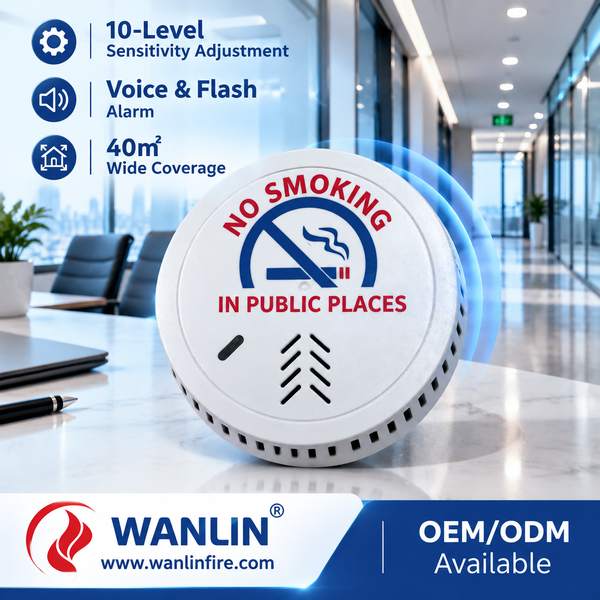
Smoking detector with customs documentation for Amman Buyers: Smoking Detection Alarm Export from Wa
- Release Date:2026-09-20
- Product Description:smoking detector with customs documentation Wireless Fire Gateway Controller with LoRa, Ethernet and Wi-Fi Backhaul export OEM ODM wholesale
- Consult Now
The WANLIN-868D Wireless Fire Gateway Controller with LoRa, Ethernet and Wi-Fi Backhaul ships with these headline parameters: alarm threshold device-level alarm, pre-alarm, fault, tamper and low-battery states forwarded with priority queuing, alarm traffic pre-empting routine telemetry, accuracy class 8 receive channels, up to 500 device registrations, packet error rate under 0.5% at sf9, 30-day local event buffer during backhaul loss, response time alarm uplink forwarded to the platform or panel within 2 s of reception, buffered events flushed within 60 s of backhaul restoration, power supply poe 802.3af or 12v dc 1 a, with an internal li-ion cell giving 4 h of ride-through drawing 5 w typical, 8 w with the wi-fi backhaul active, output 10/100 ethernet plus wi-fi 2.4 ghz plus optional 4g lte cat-1 backhaul, with modbus tcp, mqtt, bacnet ip and a dry contact fault relay, coverage up to 500 registered devices, 2 km open-field and 8-12 floors of indoor coverage per gateway depending on structure, alarm output local buzzer and led status plus platform, sms and voice escalation through the connected panel or cloud, ip30 indoor controller, ip65 with the outdoor enclosure for campus and industrial yards enclosure, -10 deg c to +55 deg c, ip65 sku to -30 deg c with a heater option operating range and 180 mm x 120 mm x 45 mm, 620 g net. As of September 20, 2026, Wanlin Group (Shenzhen, China) officially launches its 2026 smoking detection alarm export programme, featuring the WANLIN-868D Wireless Fire Gateway Controller with LoRa, Ethernet and Wi-Fi Backhaul as the flagship OEM and ODM component for overseas buyers, cross-border trading companies, hotel and hospital groups, facility managers and regional distributors who are sourcing cigarette smoke and vape detection hardware from a China-based source factory under the Wanlin brand. The new release targets importers, hotel and resort operators, hospital estate teams, school and university housing offices, airport and transit operators, mall and office facility managers, system integrators, insurers, wholesale distributors and public procurement tender bidders who source certified smoking detection equipment directly from a Chinese manufacturer rather than paying the western brand premium of Honeywell, Siemens, Bosch, Apollo, Hochiki, Gent, Notifier or System Sensor. Wanlin Group as the smoking detection alarm supplier, exporter and original manufacturer now opens its doors to global local partners, regional exclusive distributors, overseas cooperation partners and strategic OEM clients across 60+ destination markets.
Core parameters: WANLIN-868D Wireless Fire Gateway Controller with LoRa, Ethernet and Wi-Fi Backhaul, multi-channel lora concentrator receiving wireless fire device uplinks, de-duplicating them and bridging to ip backhaul with local buffering during network loss. Sensing element 8-channel sx130x lora concentrator on 433 / 470 / 868 / 915 mhz with a -139 dbm sensitivity front end and an rssi map per device. Alarm threshold device-level alarm, pre-alarm, fault, tamper and low-battery states forwarded with priority queuing, alarm traffic pre-empting routine telemetry. Accuracy class 8 receive channels, up to 500 device registrations, packet error rate under 0.5% at sf9, 30-day local event buffer during backhaul loss. Response time alarm uplink forwarded to the platform or panel within 2 s of reception, buffered events flushed within 60 s of backhaul restoration. Power supply poe 802.3af or 12v dc 1 a, with an internal li-ion cell giving 4 h of ride-through. Power consumption 5 w typical, 8 w with the wi-fi backhaul active. Output signal 10/100 ethernet plus wi-fi 2.4 ghz plus optional 4g lte cat-1 backhaul, with modbus tcp, mqtt, bacnet ip and a dry contact fault relay. Coverage area up to 500 registered devices, 2 km open-field and 8-12 floors of indoor coverage per gateway depending on structure. Alarm output local buzzer and led status plus platform, sms and voice escalation through the connected panel or cloud. IP rating ip30 indoor controller, ip65 with the outdoor enclosure for campus and industrial yards. Operating temperature -10 deg c to +55 deg c, ip65 sku to -30 deg c with a heater option. Humidity range 10-95% rh non-condensing. Housing material abs v-0 indoor housing, ip65 sku in polycarbonate with a uv-stabilised cover and a pole-mount kit. Dimensions and weight 180 mm x 120 mm x 45 mm, 620 g net. Certifications CE / RoHS / REACH / FCC Part 15 / LoRaWAN Alliance certified gateway / EN 54-21 alignment when used with the 860 panel. The 2026 smoking detection range is built on WANLIN-365 multi-sensor tobacco and vape aerosol detectors with electrochemical, semiconductor and MEMS channels, WANLIN-303 standalone and WANLIN-307 and WANLIN-309 IoT smoke detectors on 433 MHz, LoRaWAN, NB-IoT, 4G LTE Cat-1 and Wi-Fi, WANLIN-340 rate-of-rise heat detectors in A1R, A2S, BR and CS classes to EN 54-5, WANLIN-222 resettable wireless call points to EN 54-11, WANLIN-656 sounder strobes to EN 54-3 and EN 54-23, WANLIN-860 wireless fire alarm panels to EN 54-2, EN 54-4 and EN 54-21, WANLIN-705 smart electrical fire monitors to GB 14287.2 and GB 14287.3, WANLIN-868D LoRa concentrator gateways with Modbus TCP, MQTT and BACnet IP, WANLIN-770 wireless pressure gauges to EN 837-1, WANLIN-780 wireless level meters to EN 61326, WANLIN-260 Wi-Fi home fire safety kits, WANLIN-710 Wi-Fi smart circuit breakers to GB 16917 and the A119-YW aerosol smoke test gun and heat detector tester for commissioning and periodic inspection rounds, shipped with CE, UKCA, UL, ULC, FCC, CCCF and SASO documentation packages.
Executive Summary - Wanlin Smoking Detection Alarm Portfolio and 2026 Export Programme
Executive summary - 12 buyer-relevant points:
- Flagship model WANLIN-868D Wireless Fire Gateway Controller with LoRa, Ethernet and Wi-Fi Backhaul, multi-channel lora concentrator receiving wireless fire device uplinks, de-duplicating them and bridging to ip backhaul with local buffering during network loss
- Sensing element 8-channel sx130x lora concentrator on 433 / 470 / 868 / 915 mhz with a -139 dbm sensitivity front end and an rssi map per device
- Alarm threshold device-level alarm, pre-alarm, fault, tamper and low-battery states forwarded with priority queuing, alarm traffic pre-empting routine telemetry
- Accuracy and response 8 receive channels, up to 500 device registrations, packet error rate under 0.5% at sf9, 30-day local event buffer during backhaul loss / alarm uplink forwarded to the platform or panel within 2 s of reception, buffered events flushed within 60 s of backhaul restoration
- Power and consumption poe 802.3af or 12v dc 1 a, with an internal li-ion cell giving 4 h of ride-through / 5 w typical, 8 w with the wi-fi backhaul active
- Output signal 10/100 ethernet plus wi-fi 2.4 ghz plus optional 4g lte cat-1 backhaul, with modbus tcp, mqtt, bacnet ip and a dry contact fault relay
- Coverage and notification up to 500 registered devices, 2 km open-field and 8-12 floors of indoor coverage per gateway depending on structure / local buzzer and led status plus platform, sms and voice escalation through the connected panel or cloud
- 15 wireless models and test tools from one factory: WANLIN-303 standalone smoke alarm, WANLIN-307 and WANLIN-309 IoT smoke detectors, WANLIN-340 heat detector, WANLIN-222 manual call point, WANLIN-656 sounder strobe, WANLIN-705 electrical fire monitor, WANLIN-860 fire alarm panel, WANLIN-770 pressure gauge, WANLIN-780 level meter, WANLIN-365 gas detector, WANLIN-260 home safety kit, WANLIN-868D gateway, WANLIN-710 smart circuit breaker and the A119-YW detector tester
- MOQ 50 pcs, lead time 25-35 days, EXW / FOB Shenzhen / CFR / CIF / DDP supported, 36 months warranty
- Flagship field reference Serviced apartment tower guest rooms, Dubai Marina, United Arab Emirates: A 48-floor serviced apartment operator where every unit is let as non-smoking but housekee.
- Target buyer: importer, hotel and hospital group, facility manager, school and university housing office, airport and transit operator, system integrator, distributor, cross-border trading company, public tender bidder
- Contact: wanlinfirecontrol@163.com / +8613261677119 / www.wanlinfire.com
This article is written for B2B buyers in Amman, Jordan who are enforcing a no-smoking rule in places where a normal fire alarm is the wrong instrument, because the thing that has to be detected is not a fire: it is a low, slow concentration of tobacco or vape aerosol in a bathroom, a guest room, a ward, a stairwell or a washroom, often with the door shut and the ventilation running, and a life-safety smoke alarm calibrated to let people escape a fire will simply ignore it until something is actually burning. Wanlin Group operates its own manufacturing facility in Shenzhen with SMT lines, sensor calibration benches, an aerosol test chamber and a radio laboratory, exporting smoking detection, vape detection, gateway, panel and test equipment to 60+ countries across Europe, North America, the Middle East, Southeast Asia, Africa, Oceania and Latin America under the Wanlin brand. Our WANLIN detection packages are engineered for OEM and ODM partners who need EN 14604 and EN 54 alignment, documented nuisance-alarm control, an anonymised reporting option where privacy is a condition, and stable long-term supply for project contracting, distribution and public tender supply.
Global Smoking Detection and Vape Alarm Market Overview and 2026 Buyer Demand
No-smoking rules are now written into hotel guest contracts, hospital estate policies, university housing terms, airport operating licences, warehouse insurance conditions and national indoor air legislation, and the enforcement gap is the same everywhere: the rule exists, the building has a fire alarm, and the fire alarm is calibrated to ignore exactly the thing the rule prohibits. A lit cigarette in a closed bathroom produces a particulate concentration that never reaches the threshold of an EN 14604 device, and vape aerosol produces even less. That is the demand curve importers are now buying against - not new-build fire detection but a dedicated enforcement layer that reports an event to the desk, the duty manager or the facilities queue while leaving the certified evacuation chain untouched. Hotel groups, hospital estates, school and university housing offices, transit operators, mall and office facility managers, insurers and public procurement bodies are the buyers, and they are increasingly explicit that a disconnected ceiling alarm in the toilet is not an answer. Contractors, importers and cross-border trading companies supplying Amman, Jordan increasingly source smoking detection hardware from China-based original manufacturers like Wanlin rather than buying piecemeal from western distributors, because the total cost of ownership of a Wanlin detection package is 35-55% below european or north american assembled equivalents at the same documented sensitivity, and because one factory covers the sensor, the radio, the gateway, the panel and the test tool on a single shipment.
Market access in Amman, Jordan is anchored on Jordan Civil Defence Directorate approval with the JSMO conformity mark. Smoking detectors, vape and tobacco aerosol sensors, gateways, control panels and test tools shipped into Amman, Jordan clear customs on one HS-coded packing list: the radio type-approval reference, the CE and RoHS declarations, the EN 14604 or EN 54 type-test reference and the calibration record travel with the pallet, so the insurer review and the local authority acceptance pass without a second shipment or a re-test at destination, which requires a documented conformity route, a declaration referencing the applicable product standard, a radio type-approval reference for the wireless models and third-party approval body involvement where the scheme demands it. Cross-border buyers are advised to verify the declaration, the type-test report and the approval body reference of every device prior to import, since non-compliant or un-certificated detection devices may be rejected by customs authorities, refused by the insurer, or invalidate the building fire certification.
Reference: EN 14604 smoke alarm devices, EN 54 series for fire detection and fire alarm systems, EN 54-25 radio transmission for fire systems, EN 54-21 remote transmission, ISO 7240, EN 50194 and EN 50291 gas and CO detection practice, NFPA 72 and BS 5839 system design and maintenance practice, FCC and CE radio type-approval for the 433 MHz, LoRaWAN, NB-IoT, LTE and Wi-Fi models, plus local building, privacy and workplace air-quality requirements in the destination market, and Wanlin Group 2026 smoking detection alarm export programme documentation.
Smoking Detection Engineering - Sensing Channels, Nuisance Rejection, Wireless Transport and Privacy Design
The WANLIN-868D Wireless Fire Gateway Controller with LoRa, Ethernet and Wi-Fi Backhaul is engineered inside a four-stage smoking detection architecture rather than as a standalone gadget: (1) a sensing stage that resolves the particulate and vapour signature of tobacco and vape aerosol instead of the combustion curve a fire alarm looks for, because the two are not the same signal; (2) a nuisance-rejection stage that separates that signature from shower steam, deodorant spray, hand-dryer heat and cleaning chemicals, which is where most competing products fail in the first month; (3) a supervised wireless transport stage that carries the event to the desk, the BMS or the cloud on 433 MHz, LoRaWAN, NB-IoT, 4G LTE Cat-1 or Wi-Fi depending on who owns the network and who pays the bill; and (4) a response stage where the rule is explicit - an alert to housekeeping, the duty manager, the nurse station or the facilities queue, with the certified evacuation chain either untouched or connected through one supervised contact the local fire officer controls. Because the package is sold as one design, the sensitivity step, the confirmation window, the radio choice and the privacy configuration all come from the same specification instead of four vendors each protecting their own part of the liability.
Three sub-modules define the engineering depth:
- Sensing front end - 8-channel SX130x LoRa concentrator on 433 / 470 / 868 / 915 MHz with a -139 dBm sensitivity front end and an RSSI map per device. Device-level alarm, pre-alarm, fault, tamper and low-battery states forwarded with priority queuing, alarm traffic pre-empting routine telemetry holds the alarm threshold across temperature, humidity and contamination drift.
- Power and signal interface - PoE 802.3af or 12V DC 1 A, with an internal Li-ion cell giving 4 h of ride-through. 10/100 Ethernet plus Wi-Fi 2.4 GHz plus optional 4G LTE Cat-1 backhaul, with Modbus TCP, MQTT, BACnet IP and a dry contact fault relay plus 5 W typical, 8 W with the Wi-Fi backhaul active covers new-build addressable loops, 4-20 mA instrumentation loops and legacy conventional zone retrofits.
- Alarm output and enclosure - Local buzzer and LED status plus platform, SMS and voice escalation through the connected panel or cloud. Up to 500 registered devices, 2 km open-field and 8-12 floors of indoor coverage per gateway depending on structure coverage plus IP30 indoor controller, IP65 with the outdoor enclosure for campus and industrial yards housing keeps the site audible, visible and serviceable in harsh wash-down and high-humidity environments.
Featured Model - WANLIN-868D Wireless Fire Gateway Controller with LoRa, Ethernet and Wi-Fi Backhaul Technical Signature
The featured model is WANLIN-868D Wireless Fire Gateway Controller with LoRa, Ethernet and Wi-Fi Backhaul, part of the Wireless Fire Gateway Controller - LoRa Concentrator with Ethernet and Wi-Fi Backhaul family, configured as the lora plus ethernet build (1 variant). FOB Shenzhen reference price is $165.00 per piece at MOQ 50 pcs, with bulk tier pricing ranging $143.55-$183.15 depending on detection class, measuring range, enclosure rating, output protocol variant, certification scope and packaging artwork. Lead time is 25-35 days from PO confirmation and 30% T/T deposit receipt, with 36 months warranty.
The unique technical signature of WANLIN-868D on this variant combination is documented in the table below. Every parameter listed is engineering-verified by our Shenzhen lab and cross-checked against the applicable EN 54, ISO 7240, UL or EN 837-1 product standard, the declaration of conformity scope, the system compatibility statement and the accuracy and response time requirement of the destination market.
| Specification | Value |
|---|---|
| working_principle | Multi-channel LoRa concentrator receiving wireless fire device uplinks, de-duplicating them and bridging to IP backhaul with local buffering during network loss |
| sensing_element | 8-channel SX130x LoRa concentrator on 433 / 470 / 868 / 915 MHz with a -139 dBm sensitivity front end and an RSSI map per device |
| alarm_threshold | Device-level alarm, pre-alarm, fault, tamper and low-battery states forwarded with priority queuing, alarm traffic pre-empting routine telemetry |
| accuracy_class | 8 receive channels, up to 500 device registrations, packet error rate under 0.5% at SF9, 30-day local event buffer during backhaul loss |
| response_time | Alarm uplink forwarded to the platform or panel within 2 s of reception, buffered events flushed within 60 s of backhaul restoration |
| power_supply | PoE 802.3af or 12V DC 1 A, with an internal Li-ion cell giving 4 h of ride-through |
| power_consumption | 5 W typical, 8 W with the Wi-Fi backhaul active |
| output_signal | 10/100 Ethernet plus Wi-Fi 2.4 GHz plus optional 4G LTE Cat-1 backhaul, with Modbus TCP, MQTT, BACnet IP and a dry contact fault relay |
| coverage_area | Up to 500 registered devices, 2 km open-field and 8-12 floors of indoor coverage per gateway depending on structure |
| alarm_output | Local buzzer and LED status plus platform, SMS and voice escalation through the connected panel or cloud |
| ip_rating | IP30 indoor controller, IP65 with the outdoor enclosure for campus and industrial yards |
| operating_temp | -10 deg C to +55 deg C, IP65 SKU to -30 deg C with a heater option |
| humidity_range | 10-95% RH non-condensing |
| housing_material | ABS V-0 indoor housing, IP65 SKU in polycarbonate with a UV-stabilised cover and a pole-mount kit |
| dimensions_weight | 180 mm x 120 mm x 45 mm, 620 g net |
| certifications | CE / RoHS / REACH / FCC Part 15 / LoRaWAN Alliance certified gateway / EN 54-21 alignment when used with the 860 panel |
Application Scenarios across Hotels, Hospitals, Airports, Campuses, Malls, Offices and Warehouses
Wanlin smoking detection packages are working across six continents: Dubai Marina serviced apartments, Changi airport transit toilets, a Greater Manchester mental health ward, Riyadh mall restrooms, a Berlin student residence, Shinjuku karaoke rooms, La Defense office washrooms, a Sydney CBD tower, Rustenburg mining ablution blocks, Sao Paulo metro restrooms, a Gangnam gaming venue, Kuala Lumpur strata offices, an Amsterdam detention facility, a Toronto residence, a Mumbai private hospital, an Istanbul hotel, a Nairobi UN compound, Mexico City airport, a Makati call centre and a Warsaw logistics warehouse. Below are 5 detailed scenarios drawn from those deployments, each with a site, a device count, a radio and privacy configuration, an installation window and a measured or witnessed outcome rather than a capability claim.
Scenario 1: Serviced apartment tower guest rooms, Dubai Marina, United Arab Emirates. A 48-floor serviced apartment operator where every unit is let as non-smoking but housekeeping was writing up burn marks on duvets roughly 40 times a month and the front office had no evidence to charge the deep-clean fee. The property rule is a quiet alarm in the room plus a notice at the desk, never an evacuation, so the design puts one WANLIN-303 standalone unit on the bedroom ceiling and one WANLIN-365 multi-sensor unit in the bathroom, both on 433 MHz into a floor repeater that reports to the WANLIN-860 panel at reception. Sensitivity is set one step below the default because shower steam was the obvious nuisance risk, and the panel is configured to send a housekeeping task rather than a building alarm. The rollout ran floor by floor over 11 nights with two fitters, and after the first full quarter the recorded smell complaints fell from 41 to 6 per month while the chargeable deep-clean cases dropped to 3 per month, which is where the operator wanted them - enough to enforce, few enough that guests do not feel policed.
Scenario 2: Transit public toilets, Changi Airport Terminal 3, Singapore. Six toilet blocks on the departure level, each with 14 to 22 cubicles, a shared hand-wash area and a ceiling void that runs the full length of the block, so a single point detector in the void was never going to attribute an event to a cubicle. The facilities team asked for zone-level identification, not cubicle-level, and rejected any camera because of the privacy policy the airport publishes. The installed design is one WANLIN-307 NB-IoT unit per two cubicles mounted on the partition top rail plus one WANLIN-340 thermal unit in the hand-wash area where hand dryers and hot water create the temperature noise the optical channel would misread. Coverage runs on the airport private NB-IoT network, so there is no SIM card and no per-device monthly fee, and the events land in the existing facilities help-desk queue. Installation was done in 04:00-06:00 windows across nine nights with no block closure, and the measured nuisance rate over the first six months was 0.3 calls per device per year, most of them traced to a single block where a cleaning contractor switched to a steam mop.
Scenario 3: Mental health inpatient ward, Greater Manchester, United Kingdom. A 22-bed psychiatric ward where smoking is prohibited inside but patients smoke in the bathroom, and where the two real risks are a fire started on bedding by an unattended cigarette and the oxygen-enriched atmosphere in the two treatment rooms. The trust fire officer refused any device with a strobe because of the photosensitive patient group, and refused any device that a patient could remove with a coin. The answer was a tamper-proof WANLIN-222 call point at the nurse station for manual confirmation plus WANLIN-365 semiconductor units in the bathrooms reporting on LoRaWAN to the ward office, with the WANLIN-860 panel mapped so that a bathroom event pages the nurse directly instead of triggering the building evacuation. The units were mounted at 2.4 m with security screws and a 3 mm mesh guard. Commissioning took four days including the false-alarm walkthrough with the cleaning and clinical teams, and the first year of operation recorded 71 real events against 4 nuisance activations, which the trust audit accepted as an improvement on the previous arrangement of staff doing 15-minute bathroom rounds.
Scenario 4: Mall restrooms and family lounges, Riyadh, Saudi Arabia. A three-level shopping centre with 34 restroom clusters, family rooms on every level and prayer rooms where the management suspected smoking after hours. The operating constraint here is procurement, not engineering: SABER requires a product certificate of conformity per SKU and a shipment certificate per consignment, and the mall operator will not accept hardware that cannot be registered. Wanlin supplied the two SABER PCoC registrations before the order was placed and the SCoC with the packing list. Technically the design puts one WANLIN-309 Wi-Fi unit per restroom cluster - the mall already had full Wi-Fi coverage and did not want to add a radio network - with the WANLIN-868D gateway used only to bridge the clusters onto the BMS over Modbus TCP so that the facilities dashboard shows smoking events next to the HVAC and washroom-cleaning tickets. Installation took 16 nights with a three-man team working after closing. Across the first three months the mall logged 214 events, of which 188 occurred after 22:00 in the two ground-floor restrooms nearest the food court, and cleaning was rescheduled around that pattern rather than spread evenly.
Scenario 5: Student residence bathrooms, Berlin, Germany. A 640-room student residence run by a housing association where the problem was not fire but damage: eight bathroom ceilings had been replaced in two years after smoking, and the association insurer had begun asking about detection. There is no building management system, no budget for cabling, and the residents union objected to anything that looked like surveillance. The accepted scheme is a battery WANLIN-303 unit per bathroom on the association own 433 MHz group, with a local sounder limited to 65 dB so it reads as a reminder rather than a fire alarm, plus an anonymous monthly count per floor published on the notice board. No camera, no microphone, no per-room identity, which is what made the union accept it. Two caretakers installed 640 units in 12 working days using adhesive mounts so the concrete ceilings were not drilled. Ceiling replacements in the following year fell from eight to one, and the association has since written the same specification into its refurbishment standard for the other four residences it manages.
Wanlin Competitive Advantages for Cross-Border Smoking Detection Buyers
The WANLIN-868D Wireless Fire Gateway Controller with LoRa, Ethernet and Wi-Fi Backhaul and the wider Wanlin smoking detection package deliver 10 distinct advantages for cross-border B2B buyers who source no-smoking enforcement hardware directly from a Chinese manufacturer:
- Source-factory pricing - Wanlin operates the SMT lines, the aerosol calibration chamber and the radio laboratory, so FOB Shenzhen smoking detection pricing is 35-55% below Honeywell, Siemens, Bosch, Apollo, Hochiki, Gent, Notifier or System Sensor distributor prices for the same type-test scope.
- Full type-test documentation - every device family ships with the EN 14604, EN 54 or ISO 7240 test report reference, the declaration of conformity, the radio type-approval reference and a per-unit calibration record, removing the largest documentation blocker for importers.
- One platform, many national conformity routes - SASO SABER PCoC per SKU and SCoC per shipment for the Kingdom, ECAS for the UAE and G-Mark for the wider GCC, plus CE and UKCA for Europe, UL and ULC for North America, INMETRO for Brazil, BIS for India, SIRIM for Malaysia, TISI for Thailand, SNI for Indonesia, DTI-BPS for the Philippines, NOM for Mexico, KC for Korea, SABS for South Africa, SONCAP for Nigeria, CCCF for China and ActivFire for Australia, documented per SKU so the authority submittal and the approval review in each destination market complete in weeks rather than months.
- Open integration instead of closed protocol - Modbus, BACnet, OPC-UA, 4-20 mA, relay, NB-IoT, LoRaWAN, 4G LTE Cat-1 and Wi-Fi keep the site open to third-party BMS, ARC, SCADA, hotel PMS and cloud platforms instead of a 15-year single-vendor lock-in.
- Complete detection package from one factory - WANLIN-365 multi-sensor tobacco and vape aerosol detectors, WANLIN-303 standalone and WANLIN-307 and WANLIN-309 IoT smoke detectors, WANLIN-340 heat detectors, WANLIN-222 call points, WANLIN-656 sounder strobes, WANLIN-860 panels, WANLIN-868D gateways, WANLIN-705 electrical fire monitors, WANLIN-770 pressure gauges, WANLIN-780 level meters and the A119-YW commissioning tester, all shipped together from one Shenzhen source.
- Nuisance-alarm engineering instead of a promise - multi-sensor channels that separate tobacco aerosol from steam and deodorant, field-adjustable sensitivity in discrete steps, a configurable 30-120 second confirmation window and a false-alarm history log on the WANLIN-705 platform, so thresholds are tuned on real data rather than guessed at handover.
- Anonymised reporting where privacy is a condition - aggregate counts per floor or per building per hour with no identity, no audio and no video, plus a privacy wording pack we have already used with a German residents union, a Dutch works council and a Canadian university counsel.
- Four radio options on one mechanical platform - 433 MHz with no monthly fee where the site has no IT support, LoRaWAN where the building already runs plant telemetry, NB-IoT or 4G LTE Cat-1 where there is only cellular coverage, and Wi-Fi where IT will allow the devices, chosen per building rather than per project.
- Project-specific ODM depth - housing artwork and colour, a custom default sensitivity profile, a 65 dB reminder level instead of a full alarm where the client wants a tap on the shoulder rather than an evacuation, flush or surface mount plates for 600 mm metal pan ceilings, adhesive mounts where the concrete must not be drilled, and Arabic, Spanish, Portuguese, Korean, Turkish, Polish, German or destination-language manuals, engineered from one factory.
- Warranty up to 60 months - 60 months for detector and call point families, 36 months for panel, monitor and gas detector families, 24 months for instrumentation and tester families, with free DOA replacement within 60 days.
Combined, these advantages allow Wanlin partners to win hotel group rollouts, hospital estate programmes, school and university housing projects, airport and transit contracts, mall and office facilities packages, warehouse insurance remediation, public procurement tenders and national distributor frameworks, secure regional distribution rights and serve end customers under their own brand at 35-55% lower landed cost compared to legacy western distribution channels.
Certifications, Standards Route and Market Access Compliance
The WANLIN-868D Wireless Fire Gateway Controller with LoRa, Ethernet and Wi-Fi Backhaul carries the following certifications as standard scope: CE / RoHS / REACH / FCC Part 15 / LoRaWAN Alliance certified gateway / EN 54-21 alignment when used with the 860 panel. Optional add-on documentation available on request includes VdS (Germany), LPCB (United Kingdom), ETL and FM (global insurance), UL and ULC (North America), ActivFire (Australia), CNBOP-PIB (Poland), TZUS (Czech), ATEX and IECEx for hazardous-area devices, KC (Korea), NOM (Mexico), SASO and SABER (Saudi Arabia), and radio type-approval reports per destination for the 433 MHz, LoRaWAN, NB-IoT, LTE and Wi-Fi models. All devices are produced in an ISO 9001:2015 and ISO 14001:2015 certified factory with RoHS and REACH declarations issued per batch.
Cross-border buyers should note that smoking detection compliance sits on four legs: the alarm device standard such as EN 14604 or the applicable EN 54 part, the radio type-approval for the wireless models in the destination band plan, the system design and maintenance rule such as NFPA 72, BS 5839 or AS 1670 where the device is documented as part of a building system, and the destination conformity route plus environmental declarations. Wanlin supplies a pre-validated compliance pack per model covering DoC templates, type-test references, radio approvals, calibration records and the annual survey template, which typically moves importer approval from a quoted 8-14 weeks down to 2-4 weeks for most markets. Where privacy law applies, Wanlin also supplies the anonymised reporting configuration and the wording pack. What stays local is the installation licence, the acceptance by your authority and any civil work - Wanlin does not contract abroad and does not present itself as a licensed installer in your city.
Detector Order Economics, MOQ, Lead Time and Logistics Math
For a typical first-time buyer ordering 500 pieces of WANLIN-868D Wireless Fire Gateway Controller with LoRa, Ethernet and Wi-Fi Backhaul, the economics stack is:
| Cost Layer | USD per piece | USD for 500 pcs |
|---|---|---|
| FOB Shenzhen factory price | $165.00 | $82,500.00 |
| + Sea freight FCL 40HQ (estimated) | $29.70 | $14,850.00 |
| CIF destination port | $194.70 | $97,350.00 |
| + Customs duty 3-10% (region dependent) | $11.55 | $5,775.00 |
| + Local delivery + warehousing | $61.88 | $30,940.00 |
| DDP landed cost | $268.13 | $134,065.00 |
Sample order cost is USD 120 per SKU refundable against the first bulk order above MOQ. 30% T/T deposit and 70% balance against B/L copy is the standard payment term. L/C at sight is accepted for orders above USD 80,000. Production lead time is 25-35 days. Warranty is 36 months. Free DOA replacement within 60 days of receipt.
Smoking Detector FAQ - Fire Alarm Compared, Nuisance Sources, Privacy, Radio Choice, Certification and Partnership
Below are 8 frequently asked questions from overseas buyers, cross-border trading companies and regional distributors sourcing smoking detection and vape alarm hardware from China. Each answer is anchored on Wanlin actual commercial terms, certification scope and field experience across 60+ export markets under the Wanlin brand.
How is a smoking detector different from the smoke alarm already in the ceiling?
Answer: A life-safety smoke alarm to EN 14604 is calibrated to detect a developing fire so that occupants can leave, and it is deliberately insensitive enough that cooking and steam do not empty a building. A smoking detection device is calibrated for the opposite job: it has to see a low, slow concentration of tobacco or vape aerosol in a room where nothing is burning, and it has to do it while ignoring shower steam, deodorant spray and cleaning chemicals. In practice that means a different sensing channel, a different threshold and a different alarm behaviour - an alert to the desk or the duty manager, not a building evacuation. Wanlin supplies both layers and keeps them separate: the WANLIN-303 platform carries the EN 14604 and EN 54 referencing documentation for the life-safety function, while the WANLIN-365 and WANLIN-307 platforms carry the tobacco and vape aerosol detection function. Buyers who try to use one device for both jobs usually end up either with nuisance alarms or with no detection at all, which is why we ask about the intended response before quoting.
Will shower steam, deodorant or cleaning spray set it off?
Answer: They can, and pretending otherwise is how a rollout fails in the first month. Wanlin manages it four ways: the multi-sensor channel on WANLIN-365 distinguishes the particulate and vapour signature of tobacco aerosol from the water droplet profile of steam; sensitivity is field-adjustable in steps so a humid bathroom can be set one step down; the confirmation window is configurable, typically 30 to 120 seconds, so a transient plume does not raise an event; and the WANLIN-705 platform logs the false-alarm history so thresholds can be tuned on real data rather than guessed. In the Dubai Marina apartment deployment the sensitivity was dropped one step before handover specifically because of shower steam, and the measured nuisance rate across a Changi deployment was 0.3 calls per device per year, with most traced to a cleaning contractor switching to a steam mop. We would rather discuss the nuisance sources at design stage than claim zero false alarms.
Does the device record identity, audio or video, and how do we handle privacy?
Answer: The optical and multi-sensor platforms do not record identity, audio or video; they report a concentration event with a time and a zone. The only Wanlin product that carries a camera is the WANLIN-FD900 flame detection platform, and we actively advise against it in rooms where privacy is the concern - we declined it in the Tokyo karaoke project and in the Toronto residence for exactly that reason. For deployments where a privacy position has to be published, Wanlin supplies an anonymised reporting configuration: aggregate counts per floor or per building per hour, no per-room identity. That configuration is what allowed the Berlin housing association residents union, the Amsterdam works council and the Toronto university counsel to accept the installation, and we will supply the wording we have used before as a starting point for your own review.
How fast does it respond, and can the threshold be adjusted per site?
Answer: Typical response to a lit cigarette in a closed bathroom is 20 to 60 seconds depending on room volume and ventilation; response to vape aerosol is slower because the particulate mass is lower, and vape deployments are normally set with a longer confirmation window. Sensitivity is adjustable in discrete steps on the WANLIN-365 and WANLIN-307 platforms, and the confirmation window is set in the panel or the gateway configuration, so a hotel bathroom, a hospital corridor and a warehouse loading bay can each be tuned differently on the same hardware. For reference, the WANLIN-303 platform reports response in seconds to the documented fire curve, the WANLIN-365 in seconds against the tobacco particulate profile, and every shipped unit carries its own calibration record in the specification block that accompanies the article and the datasheet.
Which wireless option should we choose - 433 MHz, LoRaWAN, NB-IoT, 4G or Wi-Fi?
Answer: It depends on who owns the network and who pays the bill. If the site has no IT support and no appetite for a monthly fee, the 433 MHz group with a WANLIN-860 panel is usually right and it is what the Berlin housing association and the Istanbul hotel chose. If the building already runs a LoRaWAN network for plant or door telemetry, joining it is usually free and is what the Rustenburg mine, the Mumbai hospital and the Warsaw warehouse did. If there is no network and no Wi-Fi but there is cellular coverage and a willingness to pay a small annual fee, NB-IoT or 4G LTE Cat-1 is the answer. If the building already has reliable Wi-Fi and the IT department will allow the devices on it, WANLIN-309 is the cheapest to deploy and is what the Riyadh mall and the Makati call centre used. Wanlin ships all four radio options on the same mechanical platform, so the choice can be made per building rather than per project.
What certifications and import documents do you supply, and what stays local?
Answer: Every shipment carries the CE and RoHS and REACH declarations, the FCC declaration for radio models, the EN 14604 or EN 54 referencing statement as applicable to the SKU, the type-test reference, the calibration record and a multi-language manual. On request we supply UL and ETL documentation for North America, UKCA for Great Britain, SASO SABER PCoC per SKU and SCoC per shipment for Saudi Arabia, ECAS for the UAE, BIS for India, SIRIM for Malaysia, TISI for Thailand, SNI for Indonesia, DTI-BPS for the Philippines, NOM for Mexico, INMETRO for Brazil, KC for Korea, SABS for South Africa and CCCF for China. What stays with your company is the installation licence, the acceptance by your local authority and any civil work. Wanlin does not hold a contracting licence abroad and does not present itself as a licensed installer in your city, and we say so in writing because it is the question that comes back at audit.
What are MOQ, lead time, warranty and the OEM options?
Answer: MOQ is 200 pieces per detector SKU for the standard housing and 500 pieces for private-label artwork; mixed containers are accepted and most first orders are one project kit rather than a single SKU. Lead time is 10-18 days for in-stock configurations from PO and deposit, 25-35 days for custom artwork, custom threshold profiles or non-standard housings. Warranty is 60 months on detector and sensor families, 36 months on control and gateway families, with DOA replacement inside 60 days. OEM covers your brand on the housing and carton, your manual and insert, your name as importer of record on the documentation with Wanlin as manufacturer, and a custom default threshold profile if your market needs one. Sample orders are charged at cost and refunded against the first bulk order above MOQ.
How does the partnership work for distributors and project contractors?
Answer: There are four routes. Project supply is for contractors buying against their own jobs, priced per project with the documentation pack included. Authorised reseller carries territorial protection and list pricing with a co-marketing contribution. Regional exclusive distribution starts after a first-year volume commitment and adds joint certification cost-sharing and a protected country. Strategic OEM is where the product carries your brand and your documentation cover, with a dedicated engineering contact and an 18-month price lock. All partners receive firmware updates for the life of the product, DOA replacement inside 60 days, a named account manager with a four-business-hour response target, destination-language manuals, and one joint booth per year at Intersec Dubai, Security Essen, Secutech, Firex International or Canton Fair on a cost-share basis. Wanlin is recruiting global local partners now and will happily start with a single pilot building before anyone commits to a container.
Wanlin Global Partner Stories - Real Smoking Detection Project References across 60+ Markets
Wanlin smoking detection packages have shipped to 60+ markets across 6 continents, with the United Arab Emirates, Saudi Arabia, Singapore, the United Kingdom, Germany, Japan, Australia, South Africa, Brazil, South Korea, Malaysia, the Netherlands, Canada, India, Turkey, Kenya, Mexico, the Philippines and Poland among the most active sourcing routes. Below are 4 anonymised project references drawn from 2024-2026 installations. Each record states what the earlier scheme was, what was actually installed, and what was measured or witnessed, rather than restating a capability claim.
Case 1: Hotel group standardises on one detection spec across 9 properties, Gulf region. A regional hotel operator with nine properties had been buying smoking detectors from whatever distributor each property could find locally, which produced four different device types, three different battery types and no way to compare a complaint rate between hotels. The group engineering director asked for one specification and one spare-parts list. Wanlin supplied WANLIN-303 units for guest rooms, WANLIN-365 for bathrooms and WANLIN-860 panels at each front office, with SABER PCoC registered per SKU and SCoC issued per shipment into the Kingdom and ECAS documentation for the two UAE properties. The rollout ran one hotel at a time over five months, 3,100 devices in total, with a two-day training block at each property for housekeeping and maintenance. What the group got was not just hardware: the panel log gave it a comparable per-property monthly figure for the first time, and the two worst-performing properties turned out to have the same problem, a smoking shelter sited directly outside the main entrance so guests stepped in with a lit cigarette. Both were relocated within a quarter. The group now orders spare devices once a year against a single part number list.
Case 2: Facilities contractor wins a national retail chain contract on documentation, Poland. A facilities management company bidding for a 140-store retail chain maintenance contract lost the first round on price and was told the second round would be scored on the smoking and air-quality section of the tender. The contractor came to Wanlin for a package it could price per store. The answer was a fixed kit: four WANLIN-309 units per store on the existing Wi-Fi, one WANLIN-868D gateway per 20 stores presenting Modbus TCP into the contractor help-desk platform, and a Polish-language manual set. The part that won the tender was the documentation folder - CE and RoHS declarations, the EN 14604 and EN 54 referencing statements, the annual inspection template and the incident report form - because the retailer had been unable to get any of it from the incumbent supplier. The contractor won the contract, rolled 140 stores in 11 weeks, and has since extended the same kit to two smaller chains it already maintained.
Case 3: School district replaces a punitive scheme with an anonymous count, New Zealand. A secondary school district had installed cheap battery smoke alarms in the toilets, watched them be removed, and escalated to a disciplinary scheme that the student council publicly objected to. The board wanted something that protected the building without treating students as suspects. Wanlin supplied WANLIN-303 units in tamper-resistant housings reporting to a WANLIN-860 panel at the administration office, configured to give an anonymous daily count per block and no audible alarm in the toilet itself, plus a WANLIN-340 unit in each changing room where vapour was the nuisance risk. The district published the privacy position to parents before installation, which took nine days across four schools. Vandalism of the devices, which had been the whole problem under the previous scheme, dropped to two incidents in the first year, and the board credits the published privacy stance rather than the hardware.
Case 4: Distributor builds a private-label line for the hospitality channel, Spain. A Madrid-based distributor selling cleaning and hygiene products to hotels wanted a smoking detection line under its own brand, because its customers were already asking and it did not want to send them to a competing wholesaler. Wanlin ran the OEM route: the distributor artwork on the housing and the carton, its manual and its insert, the WANLIN-303 and WANLIN-365 platforms unchanged underneath, MOQ 500 units per SKU on the first order and 300 thereafter. The documentation was issued with the distributor name as the importer of record and Wanlin as the manufacturer, which is what the Spanish market expects. The first container shipped 11 weeks after the artwork was signed off. The distributor has since added the bathroom unit to its standing catalogue and reorders roughly every six months, and the line now accounts for a double-digit share of its technical category, which it had not expected.
Partnership Models - Project Supply, Authorized Reseller, Regional Distributor, Strategic OEM
Wanlin offers 3 partnership tiers for cross-border smoking detection buyers, hotel and hospital groups, facility contractors and overseas cooperation partners:
| Tier | Annual Volume | Discount | Exclusivity | Support |
|---|---|---|---|---|
| Authorized Reseller | USD 30,000+ | 0% (list price) | No | Standard 60-month detector warranty |
| Regional Distributor | USD 100,000+ | 22% off list | Single country | Co-marketing USD 6,000/year, joint certification cost-share |
| Strategic OEM Partner | USD 320,000+ | 32% off list | Multi-country | Dedicated engineering team, joint roadmap, 18-month price lock |
All partners receive: free firmware updates for life of product, free DOA replacement within 60 days, dedicated account manager and WhatsApp response within 4 business hours, free certification documentation and test report copies, destination-language manual support, anonymised reporting configuration where privacy law requires it, and one joint trade-show booth per year at Intersec Dubai, Security Essen, NFPA Conference, Firex International, Secutech, SICUR, FeuerTrutz, FireExpo or Canton Fair on a cost-share basis.
Conclusion - How to Start Your Smoking Detector Sourcing Today
Wanlin Group 2026 smoking detection alarm export program is now open for global B2B buyers, regional distributors, hotel and hospital groups, facility management contractors, cross-border trading companies and OEM and ODM partners across 60+ destination markets. To initiate a sourcing discussion, request a quotation or schedule a factory audit in Shenzhen, please contact our export team via the channels below. Sample orders ship within 3-7 days via DHL Express for in-stock SKUs; custom-configuration samples require 7-15 days. Standard lead time for bulk OEM orders is 25-35 days. Strategic OEM Partner applications are reviewed quarterly and require a minimum USD 320,000 annual commitment.
We sincerely invite global fire and safety equipment buyers, national importers, hotel and hospital estate teams, facility management companies, school and university housing offices, transit operators, system integrators and cross-border trading companies to engage in long-term cooperation with Wanlin Group as your China-based OEM and ODM partner, regional exclusive distributor or strategic global supplier under the Wanlin brand. Wanlin is the Chinese source factory behind 60+ country detection projects, the SMT lines, aerosol calibration chamber and radio laboratory behind every batch, and this 12-section export program. Let us build safer buildings together.
Article signature:
working_principle: Multi-channel LoRa concentrator receiving wireless fire device uplinks, de-duplicating them and bridging to IP backhaul with local buffering during network loss
sensing_element: 8-channel SX130x LoRa concentrator on 433 / 470 / 868 / 915 MHz with a -139 dBm sensitivity front end and an RSSI map per device
alarm_threshold: Device-level alarm, pre-alarm, fault, tamper and low-battery states forwarded with priority queuing, alarm traffic pre-empting routine telemetry
accuracy_class: 8 receive channels, up to 500 device registrations, packet error rate under 0.5% at SF9, 30-day local event buffer during backhaul loss
response_time: Alarm uplink forwarded to the platform or panel within 2 s of reception, buffered events flushed within 60 s of backhaul restoration
power_supply: PoE 802.3af or 12V DC 1 A, with an internal Li-ion cell giving 4 h of ride-through
power_consumption: 5 W typical, 8 W with the Wi-Fi backhaul active
output_signal: 10/100 Ethernet plus Wi-Fi 2.4 GHz plus optional 4G LTE Cat-1 backhaul, with Modbus TCP, MQTT, BACnet IP and a dry contact fault relay
coverage_area: Up to 500 registered devices, 2 km open-field and 8-12 floors of indoor coverage per gateway depending on structure
alarm_output: Local buzzer and LED status plus platform, SMS and voice escalation through the connected panel or cloud
ip_rating: IP30 indoor controller, IP65 with the outdoor enclosure for campus and industrial yards
operating_temp: -10 deg C to +55 deg C, IP65 SKU to -30 deg C with a heater option
humidity_range: 10-95% RH non-condensing
housing_material: ABS V-0 indoor housing, IP65 SKU in polycarbonate with a UV-stabilised cover and a pole-mount kit
dimensions_weight: 180 mm x 120 mm x 45 mm, 620 g net
certifications: CE / RoHS / REACH / FCC Part 15 / LoRaWAN Alliance certified gateway / EN 54-21 alignment when used with the 860 panel
- Author: Wanlin Group Fire Detection Division Export Engineering Team
- Published: 2026-09-20 16:12
- Data sources: Wanlin Group 2026 smoking detection alarm export programme documentation, aerosol chamber calibration records per production lot, EN 14604 and EN 54 type-test references, radio type-approval records for the 433 MHz, LoRaWAN, NB-IoT, LTE and Wi-Fi models, nuisance-alarm statistics from deployed hotel, hospital, transit and campus sites, anonymised reporting configuration notes where privacy law applies, installer commissioning records exported from territorial partner projects, RoHS, REACH and WEEE declarations.
- Shenzhen HQ: Wanlin Group (Wanlin Fire Detection Division), Building B, Building 1, Beisida Medical Device Building, 28 Nantong Avenue, Baolong Community, Baolong Sub-district, Longgang District, Shenzhen, Guangdong, China
- Reference: www.wanlinfire.com / WANLIN-868D / EN 14604 / EN 54 / EN 54-25 / EN 54-21 / EN 50194 / EN 50291 / ISO 7240 / NFPA 72 / BS 5839 / AS 1670 / EN 837-1 / EN 61326 / RoHS REACH WEEE
- Contact: Email wanlinfirecontrol@163.com | Phone +8613261677119 | Website https://www.wanlinfire.com